Nobody is going to be fined for a late MTD update this year
And almost every guide says otherwise
If you have read anything about Making Tax Digital for Income Tax in the past few months, you will have met a particular sentence. It appears in accountancy blogs, in software vendors' help pages, in the AI-written explainers that now fill the first page of search results. It goes something like this: miss a quarterly update and you get a penalty point; collect four points and HMRC fines you £200.
That is a fair description of the penalty regime. It is not a description of what happens this year.
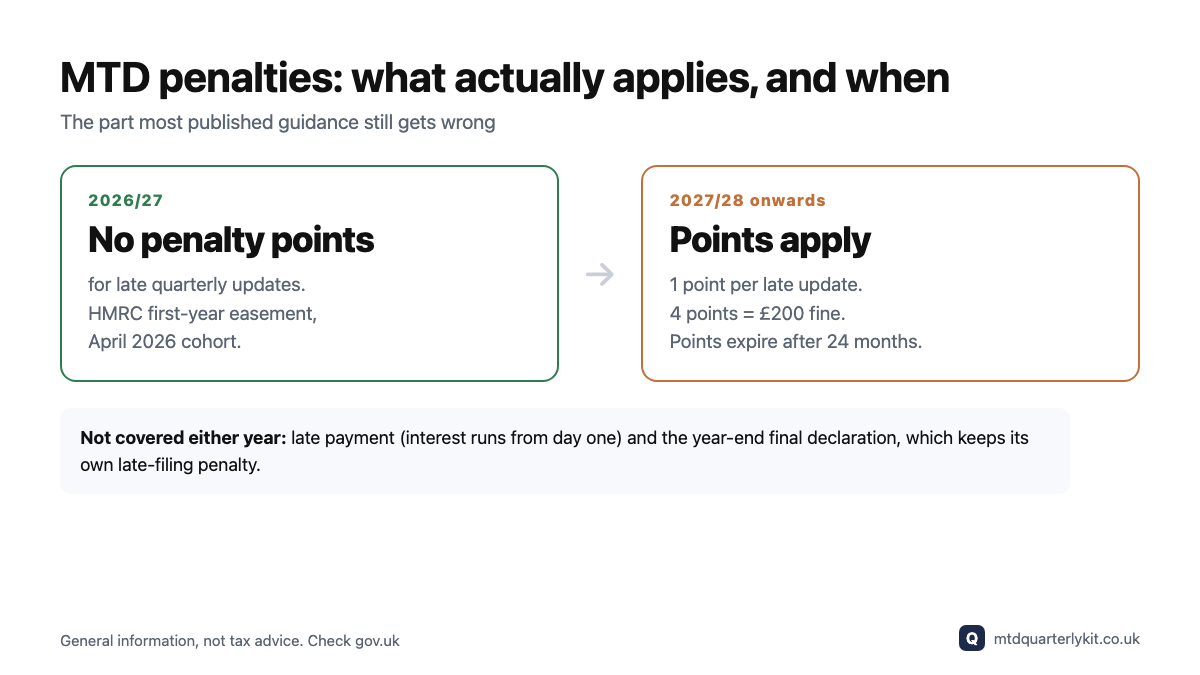
HMRC has confirmed a first-year easement for the April 2026 cohort. No penalty points are issued for late quarterly updates in 2026/27. The points system starts in 2027/28. If you are one of the sole traders or landlords brought into MTD for Income Tax this April, and you filed your first quarterly update late, or have not filed it at all, you have not accumulated a point. There is nothing to accumulate yet.
We published the wrong version too
This is not a piece written from a position of superiority. We had the standard, incorrect version on our own site for a few days. A landlord on a forum pushed back on it. We went and checked against ICAS and ICAEW commentary rather than against other people's blog posts, found the easement, and rewrote the page.
The reason so much guidance is wrong is fairly mundane. The penalty rules were published first and widely summarised. The easement came later and was reported in professional channels rather than consumer ones. Anything written by summarising other summaries inherits the original, and there is now a great deal of writing produced that way. If three sources agree, it is worth asking whether they are three sources or one source copied twice.
What the easement does not cover
The soft landing is narrow, and the parts it leaves out are the parts that cost money.
It does not cover late payment. Interest runs from day one on tax paid late, regardless of your quarterly update record.
It does not cover the final declaration. That replaces your Self Assessment return, it is due 31 January 2028 for the 2026/27 tax year, and it keeps its own late-filing penalty.
And it does not remove the obligation to file. The quarterly updates are still required. You cannot complete the final declaration until all of them are in, so an update skipped in November is an update you are doing in a hurry the following January alongside everything else.
The rules underneath, briefly
MTD for Income Tax has been mandatory since 6 April 2026 for sole traders and landlords whose combined gross income from self-employment and property is over £50,000. Gross means before expenses. The test is applied per person, combined across both types of income, based on a tax return you have already filed. The threshold drops to £30,000 in April 2027 and £20,000 in April 2028. Nothing below £20,000 has been confirmed.
If you are in, three things are required: keep digital records, send quarterly updates through recognised software, and file a year-end final declaration in place of the Self Assessment return.
Two points that are routinely misunderstood. Quarterly updates do not mean paying tax quarterly. Tax for 2026/27 is still due on 31 January 2028, plus payments on account where they apply. And the updates contain category totals, not individual transactions. HMRC is not receiving your bank feed.
The deadlines for 2026/27
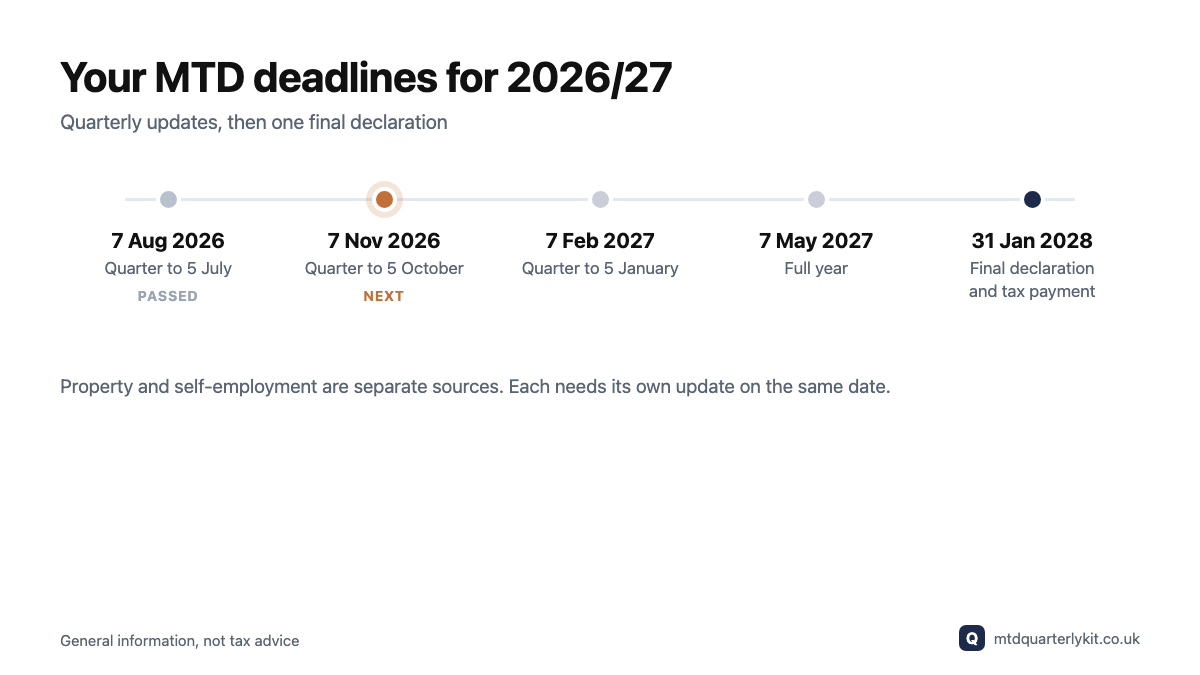
- Quarter to 5 July, due 7 August 2026 (now passed)
- Quarter to 5 October, due 7 November 2026
- Quarter to 5 January, due 7 February 2027
- Quarter to 5 April, due 7 May 2027
- Final declaration, due 31 January 2028
If you have both self-employment and property income, they are separate sources and need separate quarterly updates, submitted on the same deadline.
Why the correct version is the more reassuring one
There is a second thing the scary guides tend to omit, and it matters more than the penalties.
Quarterly updates are cumulative. Each one covers the tax year to date and replaces the one before it. A mistake in your July update does not sit there as a permanent error requiring an amendment. You correct the figure, and the next update carries the corrected running total.
Taken together with the first-year easement, that changes the character of the exercise. The design intent for year one appears to be that people learn the process. A wrong number gets fixed next quarter. A late update this year does not create a point. The thing worth protecting is the January 2028 deadline, and the way to protect it is to keep the records current rather than to panic about 7 November.
HMRC wrote to 864,000 sole traders and landlords ahead of the first deadline, as reported by IBTimes UK in August. A good number of those letters landed with people who had never heard of any of this. If that was you, and August has already gone past, you are not in trouble.
If you keep your records in a spreadsheet
You can. Spreadsheets are acceptable digital records. The condition is how the figures reach HMRC: through recognised bridging software, connected by digital links. Totals must flow by formula or software link. Retyping a number into the bridging tool, or copying and pasting it, breaks the digital link requirement even if the number is correct.
One note for landlords
Residential finance costs, mortgage interest most obviously, are not an expense. They go in their own category and attract a 20% basic-rate tax credit. Repairs on a like-for-like basis are allowable; capital improvements are not. If a property is jointly owned, you report only your share.
What to actually do before 7 November
Work out whether you are in scope, on gross combined income for a year you have already filed. If you are, get your records for 6 April onwards into a form where the category totals can be produced without retyping, and connect that to a recognised bridging tool. Then file the October quarter.
If you want a quick answer on scope and which deadlines apply to you, we run a free checker at mtdquarterlykit.co.uk/mtd-checker. It takes a couple of minutes and does not ask for anything sensitive.
And if you read somewhere that you are four missed updates from a £200 fine this year, check the date on the article.
This is general information, not tax advice. It is not a substitute for advice from a qualified accountant who knows your circumstances, and rules change. Published by Cunniffe & Helm Ltd (registered in England & Wales, no. 08990516), trading as MTD Quarterly Kit. We are not affiliated with HMRC.