The MTD threshold trap: gross income, not profit
There is a fairness problem sitting inside Making Tax Digital for Income Tax, and it is not the one people usually complain about.
It is not the software. It is not the four updates a year. It is the test that decides who has to do any of it.
The test does not look at whether you are making money.
The rule, stated plainly
Since 6 April 2026, MTD for Income Tax has been mandatory for UK sole traders and landlords whose combined gross income from self-employment and property is over £50,000. The threshold drops to £30,000 in April 2027 and to £20,000 in April 2028. Below £20,000, nothing has been confirmed.
Four words in that sentence carry all the weight.
Gross. Before expenses. Not profit, not what is left after the mortgage, not what reaches your current account and stays there. The full amount coming in.
Combined. Self-employment income and property income are added together for the test, even though they are separate sources for reporting.
Per person. Not per property, not per household, not per couple. Each individual is assessed on their own income.
Already-filed. HMRC works from a tax return you have already submitted. Your position today is judged on a year that has finished.
Employment income does not count. Neither do pensions, dividends or savings interest. A PAYE salary of £80,000 contributes nothing to the threshold test.
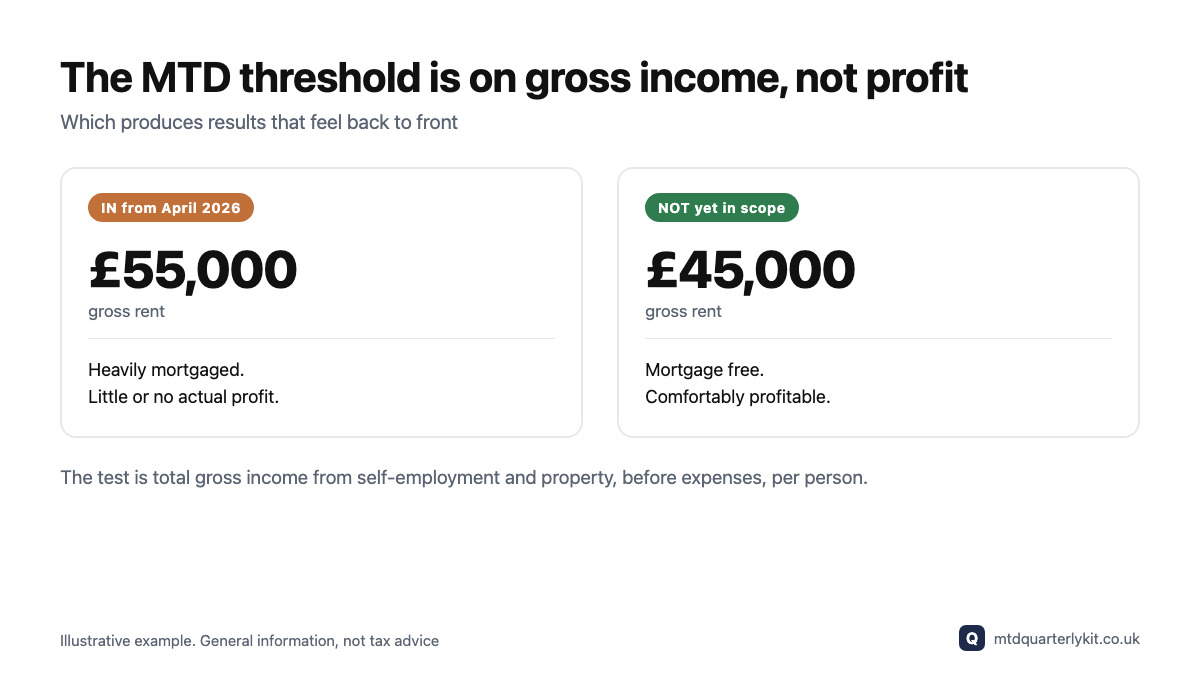
Meet Mike and Priya (both fictional)
Two illustrative examples. Both are invented, and I am flagging that clearly rather than dressing up made-up numbers as customer stories. The figures are chosen to make the arithmetic visible, not to claim anything about how common they are.
Mike is fictional, but his numbers are not unusual. He is a landlord in Leeds with two flats, bought with large mortgages. Gross rent across the two is £55,000 a year. After mortgage payments, letting agent fees, insurance, service charges and a boiler that failed in February, what he actually keeps is close to nothing. Some years it is negative.
Mike is in scope from April 2026. His gross rent is over £50,000, so he keeps digital records, files four quarterly updates through recognised software, and makes a final declaration that replaces his Self Assessment return.
Priya is also fictional. One property, no mortgage, inherited years ago. Gross rent £45,000. Her costs are modest — insurance, a bit of maintenance, an agent — so most of that rent is profit.
Priya is not in scope yet. She is under £50,000. She will be caught when the threshold drops to £30,000 in April 2027, but for now she carries on with an annual return.
So the landlord earning nothing does quarterly reporting, and the landlord earning a good living does not. Priya has more taxable profit than Mike. Mike has more admin.
That is not a loophole. It is what a gross-income test produces. A profit-based test would need HMRC to know your profit before you had reported it, which is circular. Gross income is the figure available in advance, so gross income is what they use. The logic holds. The outcome still looks odd from where Mike is standing.
Mike's real problem is worse than the paperwork
There is a second layer to Mike's situation, and it is the part that catches leveraged landlords out.
Mortgage interest is not a deductible expense against rental income. It gets a basic-rate tax credit at 20% and has its own category in the reporting. So the money leaving Mike's account every month does not reduce his rental profit the way it feels like it should. His taxable profit is meaningfully higher than his actual profit.
The gross test pulls him in, and the interest rules mean his tax bill is larger than his bank balance suggests. Those are two separate rules producing one uncomfortable result.
Worth knowing alongside that: like-for-like repairs are allowable, capital improvements are not. Rent-a-Room receipts and lease premiums have their own categories.
Joint ownership: one of you can be in and the other out
Consider a fictional couple who own a rental property 50/50.
Each of them reports their own share and only their share. The threshold is assessed per person, on that share.
So if the property produces £60,000 gross, neither of them has £60,000 for the test. They each have £30,000 — under the £50,000 threshold for 2026.
But suppose one of them also runs a small consultancy turning over £25,000. That is combined with their £30,000 property share, giving £55,000. They are in scope. Their partner, with only the property share, is not.
Same property. Same bank account. Same tenants. One of them files quarterly updates and the other files an annual return, and that will feel absurd until you remember the test never looks at the household.
Two updates, incidentally, not one: property and self-employment are separate sources requiring separate quarterly updates, due on the same date.
A job plus a side hustle
Another illustrative case. Someone employed full-time on £60,000, running a small business on the side that turns over £15,000 gross.
The salary is invisible to the threshold test. PAYE does not count. Only the £15,000 self-employment income does, so they are nowhere near the 2026 threshold — and still under the £30,000 threshold in 2027.
This runs both ways, and the second direction catches people. Someone might assume that because they are "mostly employed", MTD cannot apply to them. But if the side business grows past the threshold on its own, the salary does not protect them. It simply is not part of the calculation.
Scaling back now does not get you out
This is the consequence of the already-filed test, and it is the one that surprises people most.
HMRC looks at a return you have already submitted. If Mike sells a flat next month, or halves his rents, or stops letting entirely, that does not remove him from the current mandate. The return that put him in scope has been filed. It does not un-file itself.
The same works in reverse for anyone hoping to stay out. A good year, filed, can pull you into scope for a later year in which you are doing much less business.
Practically, this means the threshold is something to watch on the return you are about to submit, not the year you are living in. By the time you notice, the decision has usually already been made.
What to actually do about it
Nothing about this is a reason to panic, and none of it changes when tax is paid — quarterly updates are not quarterly payments. Tax for 2026/27 is still due on 31 January 2028.
The useful step is simply to check the right number. Add up gross self-employment and gross property income for the individual — not the household, not the profit, not what is left after the mortgage — and compare it against £50,000 now, £30,000 from April 2027, and £20,000 from April 2028.
Then look at your last filed return, because that is the one HMRC is working from.
If you would rather have something do the arithmetic, there is a free checker at mtdquarterlykit.co.uk/mtd-checker that answers exactly this question.
And if you are in scope: spreadsheets are still allowed. You can keep digital records in a spreadsheet and file through recognised bridging software, provided the totals move by digital link — a formula or a genuine link, never retyped by hand.
This article is general information, not tax advice. It is not a substitute for advice from a qualified accountant who knows your circumstances. Mike, Priya and the couple described above are fictional illustrations, not customers. Published by Cunniffe & Helm Ltd (registered in England & Wales, no. 08990516), trading as MTD Quarterly Kit. We are not affiliated with HMRC — check gov.uk for the current official position.