Making Tax Digital is quietly good for landlords, and nobody wants to say so
Almost everything written about Making Tax Digital for Income Tax is an outrage piece. More admin. More software. More cost. HMRC piling paperwork onto people who already work weekends.
Some of that is fair. It is genuinely more admin, and I will come to the costs later, because an article that only lists the good bits is worth nothing.
But there is an honest case for the other side, and nobody seems willing to make it. So here it is.
First, the shape of the thing, briefly. Since 6 April 2026, MTD for Income Tax has been mandatory for UK sole traders and landlords whose combined gross income from self-employment and property is over £50,000. Gross means before expenses. Combined means both sources added together. It is assessed per person, based on a return you have already filed. The threshold drops to £30,000 in April 2027 and £20,000 in April 2028, so a lot of people currently reading this with mild interest will be reading it with real interest in eighteen months.
The requirements are three: keep digital records, send quarterly updates through recognised software, and make a year-end final declaration that replaces your Self Assessment return. HMRC wrote to 864,000 sole traders and landlords ahead of the first deadline, so the letters have landed.
Now the case.
Mistakes stop compounding
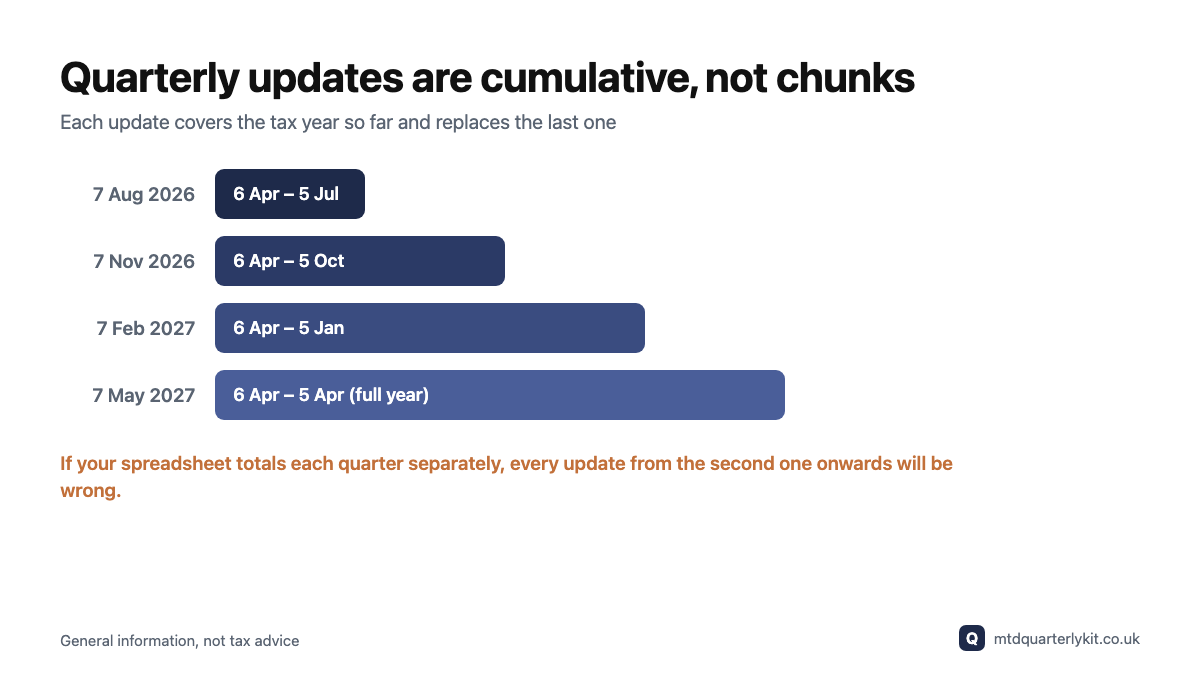
This is the part almost nobody explains properly, and it is the single best design decision in the whole system.
Quarterly updates are cumulative. Each one covers the tax year so far and replaces the one before it. Your November update is not "quarter two" — it is April to the end of the second quarter, whole. Your February update is April to the end of the third quarter.
Which means: if you get a quarter wrong, you do not resubmit anything. You fix the figure in your records and the next update carries the corrected total. The error disappears on its own.
Compare that with the old model, where a mistake sat quietly in a spreadsheet from April until you found it the following January, by which point it had been copied forward three times and you were reconstructing a year of bank statements at eleven at night. Under MTD, an error has a maximum shelf life of about three months.
That is a genuinely better system, and it is not a small thing.
You find out where you stand four times a year
Under Self Assessment, the standard experience is discovering your tax position in January, for a year that ended the previous April, nine months after you could have done anything about it.
Under MTD, you assemble your income and expense totals four times a year. You do not get a binding calculation from that, and I would not oversell it — the updates contain category totals, not a finished tax bill. But you know your income. You know your expenses. You know roughly what shape the year is in, while there is still year left.
To be clear about a common misunderstanding: quarterly updates do not mean paying tax quarterly. Nothing about the payment dates has changed. Tax for 2026/27 is still due on 31 January 2028. What changes is when you find out, not when you pay.
The shoebox ritual dies
Everyone who has done this knows the ritual. A carrier bag of receipts, a bank statement export, a December afternoon that becomes a December evening, trying to remember what a £340 payment to a builder in June was actually for.
Doing books in four small regular chunks is less painful than one annual archaeology session. It is not less work in total — it is possibly slightly more — but it is work done while you still remember what the transactions were. Annual reconstruction from memory is the worst possible way to do bookkeeping, and it is precisely what the old deadline structure encouraged.
You will probably claim more
This follows directly from the last point, and it is the argument I would lead with if I were HMRC, which I am not.
Expenses that are recorded when they happen get claimed. Expenses reconstructed from memory eight months later get missed. The small ones especially — the mileage, the cheap tools, the certificate, the letting agent's one-off fee.
For landlords there is a further reason to keep good records rather than approximate: the rules have edges you cannot navigate from memory. Mortgage interest is not an expense at all — it goes in its own category and gives you a basic-rate credit at 20%. Like-for-like repairs are allowable; improvements are not. If you own a property jointly, you report your share and only your share. Property income and self-employment income are separate sources needing separate updates. None of that is hard, but none of it survives a December guessing session intact.
It separates "money in the account" from "profit"
This is where a lot of small landlords come unstuck, and where the quarterly rhythm quietly helps.
Rent lands in an account. It feels like income. It is not profit, and for a leveraged landlord it may be a long way from profit, because the mortgage interest sitting in that account movement is not deductible in the way it feels like it should be.
Being made to sort transactions into categories four times a year forces the distinction into view. People who have been treating their rental account balance as a rough proxy for how they are doing will find out otherwise sooner. Unpleasant, possibly. Useful, definitely.
2026/27 is a free run-through
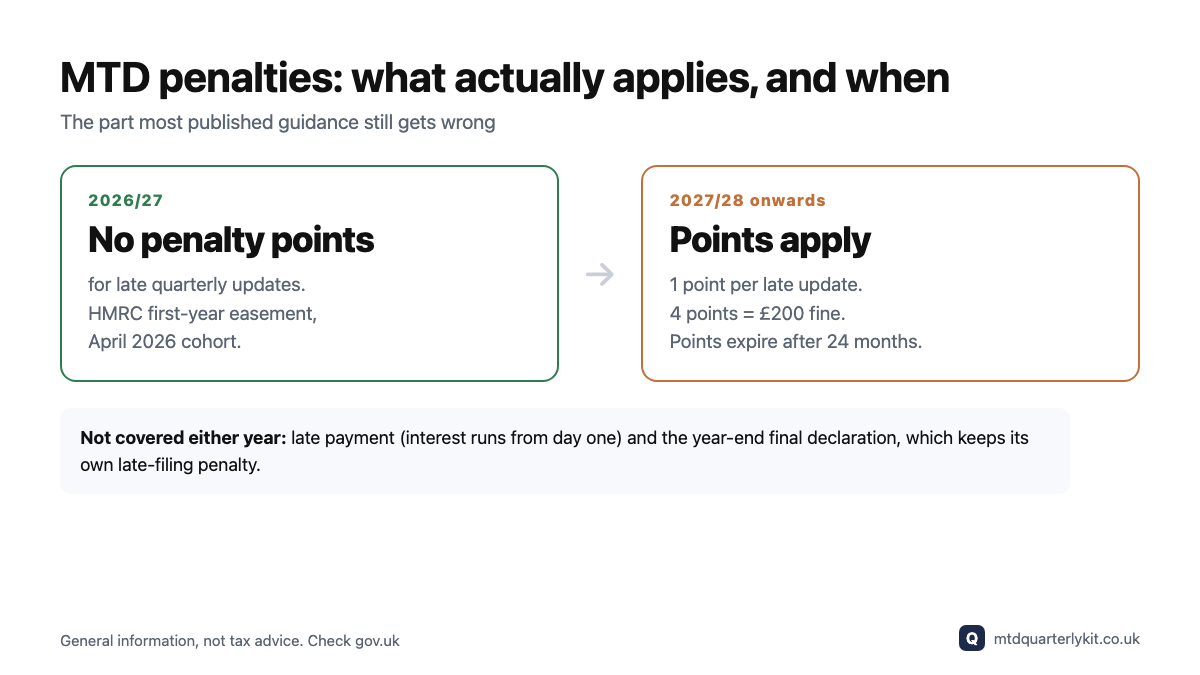
This is the most underreported fact in the whole rollout.
There are no penalty points for late quarterly updates in 2026/27. HMRC has applied a first-year easement for the April 2026 cohort. From 2027/28 the real regime starts: one point per late update, £200 charged at four points, points expiring after 24 months.
So for this year, the quarterly updates are effectively a practice run with the penalties switched off. A free year to learn a new tax system is a rare thing, and it will not be offered again to this group.
Two important limits. The easement does not cover late payment — interest runs from day one, as always. And it does not cover the final declaration on 31 January 2028. Those still bite.
The remaining deadlines for 2026/27 are 7 November 2026, 7 February 2027 and 7 May 2027. The first, 7 August 2026, has passed.
Now the honest costs
None of the above makes MTD free.
It is more admin events per year. Four updates plus a final declaration, instead of one return. Even if each one is small, five occasions on which you must do something is more demanding of attention than one, and attention is the scarce resource for most people running a business alongside a life.
There is a tooling requirement, and it is not optional. You cannot file a quarterly update directly on the HMRC website; it has to go through recognised software. Full accounting software runs roughly £10–30 a month, so £120–360 a year as of mid-2026 — worth checking current pricing. That is real money for someone with two flats and a spreadsheet that has worked fine for a decade.
Spreadsheets are still allowed, which is less well known than it should be. You can keep digital records in a spreadsheet and file through recognised bridging software, provided the totals move by digital link — a formula or an actual link, never retyped by hand. Bridging tools cost considerably less than full accounting packages.
And for someone with genuinely simple affairs — one property, one tenant, a handful of transactions a year — the whole apparatus is arguably overkill. The benefits I have described scale with complexity. If your records fit on one side of paper, quarterly cumulative updating is solving a problem you did not have.
Where that leaves it
MTD is a reasonable system with a bad reputation, aimed partly at people who did not need it.
If you are in the group that has to do it, the design is more forgiving than the coverage suggests, this year is cheaper to get wrong than any year that follows, and the habits it forces are ones most people would benefit from anyway.
If you are not sure whether you are in scope — and the gross-income, combined-sources test catches people who assume they are safely under — there is a free checker at mtdquarterlykit.co.uk/mtd-checker that will tell you in a couple of minutes.
This article is general information, not tax advice. It is not a substitute for advice from a qualified accountant who knows your circumstances. Published by Cunniffe & Helm Ltd (registered in England & Wales, no. 08990516), trading as MTD Quarterly Kit. We are not affiliated with HMRC.